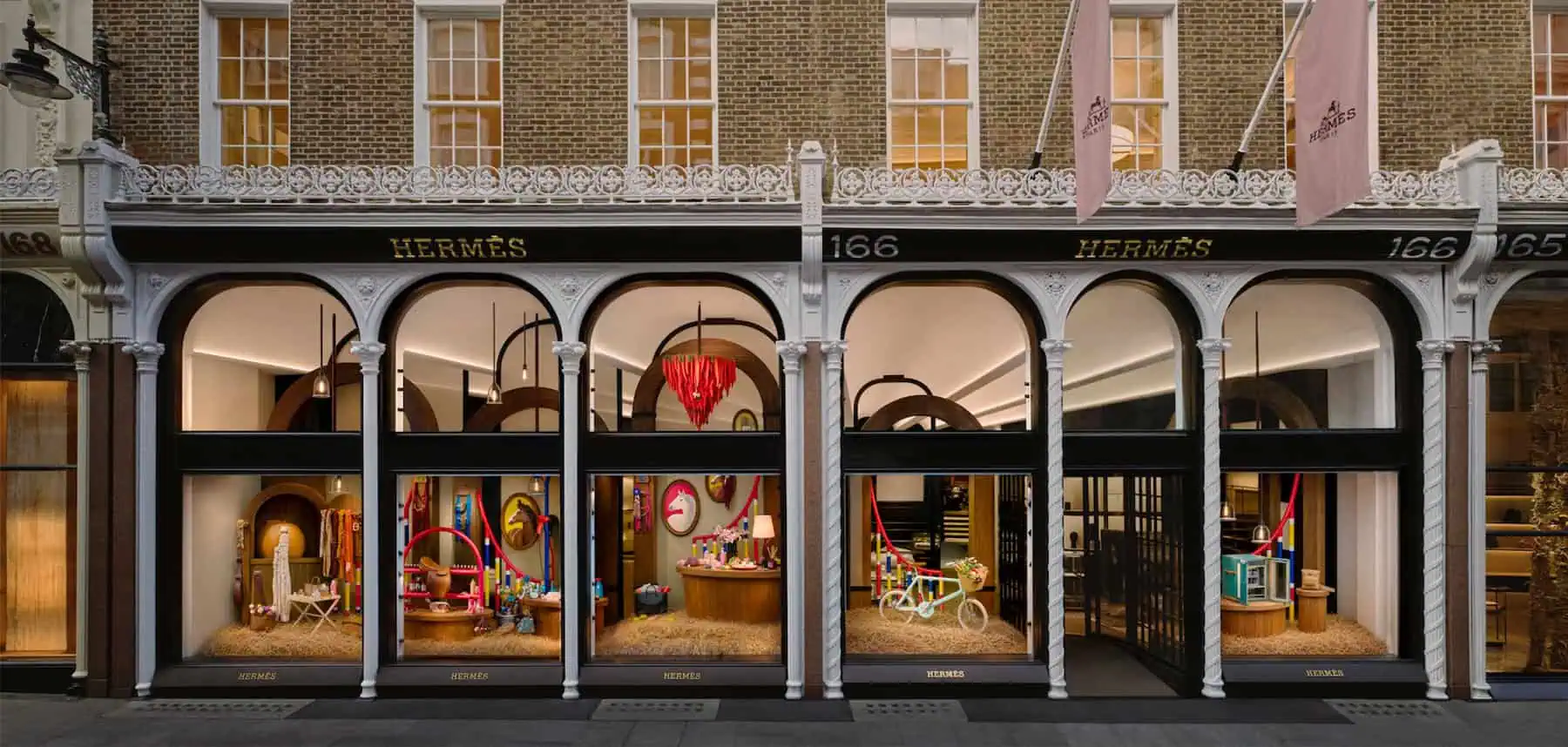
Hermès does not expand its retail footprint to chase volume. It expands to manipulate market signals.
The brand’s massive flagship on London’s New Bond Street is not a reactive customer-service move. It is a deliberate exercise in spatial arbitrage—a statement about where the French luxury house believes global wealth and cultural capital are consolidating.
While casual observers see a sprawling, six-story luxury Maison, industry analysts recognize a deeper institutional strategy underneath the limestone facade. In an era of shifting macroeconomic pressures, Hermès is rewriting the laws of retail productivity.
1. Capitalising on the Resilient UHNW Segment
The Post-Brexit Luxury Slowdown
The UK luxury market is facing a documented structural slowdown. With domestic growth trailing continental Europe and the removal of tax-free shopping diverting high-spending tourists to Paris and Milan, traditional luxury brands are retreating into defensive postures.
The Insulation of Elite Wealth
Yet, Hermès consistently outperforms the broader luxury index. Why? Because its business model is entirely insulated from middle-class aspirational spending.
This London expansion is a calculated corporate bet on the enduring resilience of Ultra-High-Net-Worth (UHNW) individuals, particularly from the Gulf region. These consumers operate completely outside traditional macroeconomic cycles. They do not seek discounts, nor do they respond to seasonal trends. They respond strictly to scarcity, absolute craftsmanship, and the physical validation of VIP status.
2. Macroeconomic Shifts and Consumer Behaviour
The Death of Aspirational Luxury
A shifting macroeconomic landscape has fundamentally altered luxury consumer behavior. Rising interest rates, inflation, and economic uncertainty have heavily impacted the “aspirational buyer”—the middle-tier consumer who occasionally purchases entry-level luxury items like perfumes, belts, or wallets. This pullback has severely hurt mid-tier luxury conglomerates, causing steep revenue declines across the industry.
The Rise of Hard Luxury
Conversely, true UHNW individuals are shifting their capital toward “hard luxury” and hyper-scarce assets. In times of economic volatility, elite buyers view Hermès products not as discretionary fashion expenses, but as alternative asset classes. The demand for iconic pieces like the Birkin or Kelly bag actually intensifies during market downturns, as these items historically retain or appreciate in value, outperforming traditional investment portfolios.

3. Scalability Through Intentional Scarcity
The Mechanics of the Veblen Effect
The defining paradox of the Hermès corporate strategy is a concept known to economists as the Veblen effect: demand for an asset increases as its price and perceived exclusivity rise.
While typical luxury conglomerates scale revenue by aggressively increasing manufacturing volume, Hermès scales by artificially capping it. They expand their physical square footage while keeping artisan production intentionally, meticulously slow.
Protecting the Secondary Market
This strict supply-side bottleneck insulates the brand from overstocks and protects its primary asset—secondary market resale value.
Increasing the physical size of a boutique without increasing product availability heightens the competitive tension of the waitlist. More retail space does not mean more product. It means more brand theater, more private client salons, and total control over the consumer experience. Hermès maximizes store productivity not by selling more units, but by engineering a world where supply never catches up to desire.
4. Case Study: The Ferrari Playbook
Maximising Demand Through Under-Supply [1]
Hermès is not alone in using this model. Automotive titan Ferrari has built a multi-billion-dollar empire on the exact same framework. Ferrari’s founder famously stated that the company would always produce “one less car than the market demands.”
By strictly limiting production numbers while simultaneously building massive, state-of-the-art experiential showrooms globally, Ferrari ensures that its vehicles are instantly sold out years in advance.
[Traditional Luxury Model] ➔ Higher Demand ➔ Increase Production ➔ Market Saturation ➔ Diminished Equity
[The Hermès/Ferrari Model] ➔ Higher Demand ➔ Cap Production ➔ Heightened Scarcity ➔ Exponential Equity
The Luxury Real Estate Illusion
Like Ferrari, Hermès uses grand physical real estate not to distribute more inventory, but to anchor its status as a cultural institution. The vast, multi-floor New Bond Street flagship functions exactly like a Ferrari showroom: it exists to celebrate the brand’s mythology and cater to top-tier collectors, while the actual product remains fiercely gatekept.
5. The Mechanics of Demand Engineering
Real Estate as a Competitive Weapon
This structural reality introduces the core question at the heart of modern high-end branding: Is Hermès expanding to meet organic demand, or are they building to fabricate it?
The reality is that elite luxury houses no longer respond to market conditions; they engineer them. By investing heavily in prime London real estate during a market dip, Hermès is actively shaping the future landscape of luxury retail.
Dominating the London Wealth Corridor
London, despite its temporary post-Brexit policy friction, remains one of the few global wealth corridors capable of staging this level of brand dominance at scale. Hermès isn’t gambling on the UK’s present economic state; they are dictating the conditions of the market they intend to monopolise.
Conclusion: The Ultimate Takeaway
The New Bond Street expansion proves that for Hermès, physical real estate is a weapon of narrative control. Reinvention in the ultra-luxury tier doesn’t mean offering new product lines; it means creating increasingly grand spaces to house the exact same limited supply.
Ultimately, Hermès teaches us that the strongest brands do not survive by adapting to the market—they survive by forcing the market to adapt to them. In a volatile global economy where attention is fleeting and consumer loyalty is rare, controlling the physical distribution channel is the ultimate form of brand equity. The real genius of the London flagship isn’t what it places on the shelves—it’s how masterfully it convinces the world that those shelves are perpetually empty.